
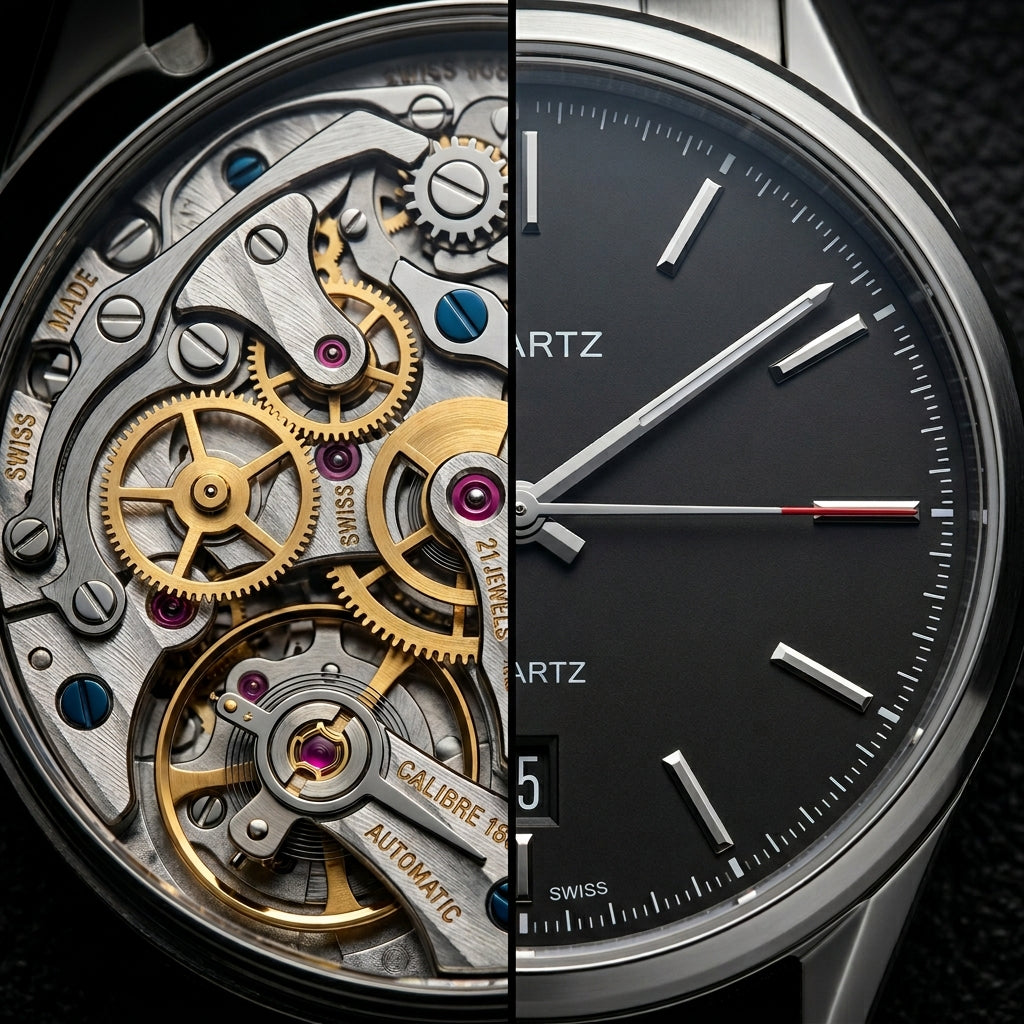
It is one of the oldest debates in horology, and it shows no signs of being resolved any time soon: mechanical or quartz? If you are new to the world of watches, the distinction can feel overwhelmingly technical. In practice, however, the choice comes down to something far simpler — what do you value most in a timepiece?
This article breaks down both movement types honestly, without brand bias or romanticism, so that you can make the decision that is right for your wrist, your lifestyle, and your budget.
What Is a Mechanical Movement?
A mechanical watch is powered entirely by stored mechanical energy — specifically, by a tightly coiled mainspring that releases tension gradually, driving a series of gears and an escapement to regulate the movement of the hands.
There are two sub-categories. A manual-wind mechanical requires the wearer to wind the crown regularly — typically every one to three days — to keep the mainspring under tension. A self-winding automatic, by contrast, uses a weighted rotor that spins with the movement of the wrist, winding the mainspring automatically throughout the day. The vast majority of modern mechanical watches are automatics.
The mechanical movement is the older of the two technologies by several centuries. Its origins trace back to 14th-century Europe, and the finest examples — found in the watches of Patek Philippe, A. Lange & Söhne, or F.P. Journe — represent decades of accumulated horological knowledge expressed in components smaller than a grain of rice.
What Is a Quartz Movement?
A quartz watch is powered by a battery, which sends an electrical current through a small piece of quartz crystal. The crystal vibrates at an extraordinarily consistent frequency — 32,768 times per second — and a circuit counts those vibrations to drive a stepper motor that moves the seconds hand in its characteristic tick.
Quartz technology was introduced commercially in 1969 with the Seiko Astron, and its arrival triggered what is now known as the Quartz Crisis — a period in the 1970s and 1980s during which Swiss mechanical watchmakers very nearly went extinct, unable to compete with the accuracy and affordability of battery-powered movements. The Swiss industry survived largely through consolidation and the emergence of Swatch as an affordable, fashionable alternative.
Today, quartz movements power everything from £10 fashion watches to Grand Seiko's prestigious 9F calibre, which is accurate to within ten seconds per year and finished to a standard that rivals the very finest mechanicals.
Accuracy: An Honest Comparison
This is where quartz wins decisively, and there is no point pretending otherwise. A quality mechanical watch will typically gain or lose between five and ten seconds per day — which sounds small until you calculate that this amounts to roughly three to six minutes per year of drift. Higher-grade movements, such as Rolex's Superlative Chronometer calibres, are certified to within plus or minus two seconds per day. Still, quartz remains more accurate.
A standard quartz movement loses around fifteen seconds per month. A high-end quartz, such as a Grand Seiko or a Breitling SuperQuartz, brings that figure down to around ten seconds per year.
If your daily life demands precise timekeeping — if you work in environments where seconds matter — quartz is the more practical choice. If you are happy to sync your watch to the speaking clock every few weeks, a mechanical will serve you perfectly well.
Maintenance: What Each Requires
A mechanical watch requires a service every five to seven years, depending on the manufacturer's recommendation. During a service, a qualified watchmaker disassembles the movement, cleans every component ultrasonically, replaces worn parts, re-lubricates, reassembles, and time-tests the calibre. In the UK, a full service from a manufacturer-authorised centre typically costs between £300 and £800 for a mid-tier watch — more for complicated pieces or ultra-high-end brands.
A quartz watch requires a battery replacement every one to three years, typically costing between £5 and £30 depending on where you go. Beyond that, it generally needs a full service every ten years or so — less frequently than a mechanical, and usually at lower cost.
If you are buying a watch primarily for low maintenance and convenience, quartz wins again. If you see the servicing relationship as part of the ownership experience — and many collectors do — the mechanical service cycle becomes less of a burden and more of a ritual.
The Romantic Argument for Mechanical
Here is where the mechanical devotee will push back, and not without justification. No statistic or spreadsheet captures what it feels like to hold a fine automatic movement up to the light and watch its components work in concert. The sweeping seconds hand — moving sixty times per second rather than ticking once — is mesmerising. The sound of a quality rotor spinning as you turn the watch in your hands is deeply satisfying.
There is also the question of continuity. A mechanical watch, properly maintained, can run for generations without its fundamental components being replaced. It is not a consumable. It is a machine designed to outlast its maker, and its owner, and possibly its owner's children. This is why significant mechanical watches are described as being passed down rather than handed on.
Quartz watches, by contrast, are ultimately dependent on battery production and electronic components that may become obsolete. This is not a reason to dismiss them — many quartz references are extraordinary watches — but it is worth considering if longevity across generations is part of your motivation for buying.
Which Should You Choose?
Choose mechanical if: you are drawn to craft and heritage, you want a watch you can pass on, you enjoy the ownership ritual of winding or wearing your watch regularly, and accuracy within a few seconds per day is perfectly acceptable.
Choose quartz if: you want precise timekeeping with minimal fuss, you prefer lower long-term maintenance costs, you travel frequently across time zones (quartz watches are easier to adjust), or your budget is better spent on case finishing and design than on movement complexity.
Consider both: there is absolutely no rule that says you can only own one watch. Many collectors have a mechanical for weekends and meaningful occasions, and a high-quality quartz for daily business use.
The right movement is the one that fits your life. Full stop.


Leave a comment
This site is protected by hCaptcha and the hCaptcha Privacy Policy and Terms of Service apply.